Boost your production
with robust industrial furniture

Ellan
Boost your production
with robust industrial furniture
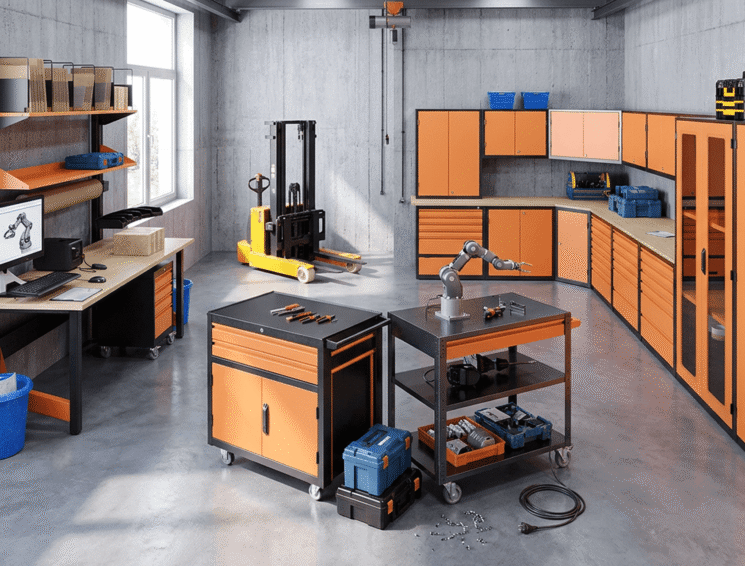
For decades, industrial furniture was synonymous with heavy, static structures that were difficult to adapt. Overly robust workbenches, cabinets welded to the floor, and makeshift carts were part of everyday life in factories.
But the industry has changed — and so has the furniture.
Today, modern factories require agility, ergonomics, modularity, safety and precision, And industrial furniture has evolved to keep pace with this new scenario.
In this article, you will understand how this transformation occurred and why… intelligent modular structures, Systems like those developed by Ellan are essential for high-performance industrial operations.
Traditional industrial furniture was made with:
It fulfilled its role of resisting, but it had important limitations:
❌ difficult to move
❌ Difficult to adapt to the layout
❌ Difficult to integrate with accessories
❌ Difficult to operate ergonomically
❌ Difficult to keep organized
Industrial environments were less flexible, and processes had to adapt to the furniture—not the other way around.
The implementation of methodologies such as:
…brought a new perspective to the factory floor: Flexibility and organization directly impact industrial performance.
It became clear that:
✔ Static furniture hindered the flow of movement.
✔ Ergonomics improved operator performance.
✔ Integrating accessories reduced waste.
✔ Modularity facilitated standardization.
That’s when the second phase of evolution began.
Modular industrial furniture has marked a new level of efficiency.
With him, the following emerged:
Advantages that revolutionized the factory floor:
✔ Quick layout adaptations
✔ Reorganization without halting production
✔ Instant accessory integration
✔ Reduced setup time
✔ More ergonomic and organized work
This is the type of furniture that grows with the factory—not one that limits its expansion.
Modern structures, such as those manufactured by Ellan, represent the ultimate evolution of industrial furniture:
Advanced materials combine the strength of steel with structural lightness.
Allows for relocation, reconfiguration, and quick installation.
Each module can be integrated, removed, or reconfigured according to the operation.
Adjustable heights, soft drawers, anti-glare surfaces, and quick access to equipment.
Furniture prepared for:
Designed to withstand decades of operation under impact, weight, and high demands.
The transformation is not aesthetic — it’s operational.
With modular furniture, the factory gains:
Operators don’t waste time searching for tools or adjusting positions.
Sensitive processes are executed with greater stability and precision.
Clean, standardized, and safe environment (pure 5S).
Production lines can be reconfigured without stopping production.
High-strength materials reduce accidents and failures.
Less fatigue, fewer errors, more performance.
Tubular workbenches with modular accessories have increased productivity and standardized workstations on a large scale.
Adjustable workbenches, integrated technical lighting, and intelligent organization have enhanced operational precision and safety.
Reinforced technical carts with a modular design have increased durability and reduced breakdowns.
These case studies show that well-designed furniture is not just a support; it’s part of the production strategy.
Industrial furniture has ceased to be merely “structure” and has become a strategic element in the efficiency of industrial operations.
From the robustness of heavy steel to intelligent modular solutions, the evolution reflects the needs of modern industry: flexibility, precision, ergonomics, and continuous productivity.
With advanced modularity, specialized engineering, and genuine durability, Ellan’s industrial furniture keeps pace with — and drives — the evolution of Brazilian factories.
Do you want a more modern, agile, and efficient operation?
Speak to Ellan and receive a customized technical project for your factory.


Boost your production
with robust industrial furniture